During a walk-through, Brian Chalsma spotted a situation that makes any experienced roofer cringe. A low-slope (or "flat") roof was tied directly into a shingle ridge vent. While a ridge vent is a fantastic tool for keeping your attic cool, it was never designed to live at the bottom of a slide.
The Problem: Gravity and Wind
The issue I saw was simple but devastating for the homeowner’s peace of mind. A ridge vent—the black, slotted piece you see at the peak of many homes—is designed to let hot air escape while shedding water that falls straight down. However, when you run a flat roof right up against it, you’re creating a path for water to pool or, worse, for our famous Tidewater winds to "drive" rain horizontally right into those vents.
The Technical "Why"
In the roofing world, "low-slope" refers to surfaces that don't have enough pitch to use gravity as their primary defense. These areas require a sealed membrane to stay watertight. A ridge vent, by definition, is an opening in your roof's "skin." When these two meet:
Backflow: Water running off the higher shingles can hit the flat transition and "back up" into the vent.
Wind-Driven Rain: Because there is no steep angle to block it, a strong gust can push water straight through the vent's baffles and onto your ceiling joists.
Manufacturer Specs: Most ridge vent manufacturers explicitly state they shouldn't be used in transitions like this because they require a certain "pitch" to function.
Professional Advice
If your home has a flat addition (like a sunroom or a porch) that meets the main roofline, it requires a specific "tie-in" detail. Usually, this involves metal flashing that tucked up under the shingles or a specialized transition membrane.
If you've noticed damp spots on your ceiling near where a flat roof meets a sloped one, it might not be a "hole" in the roof—it might just be a design flaw like the one I found. Keeping your home dry starts with a quick check-up. Whenever you're ready to take a closer look, you can reach the team at 757-867-6600 to see how we can help protect your investment.
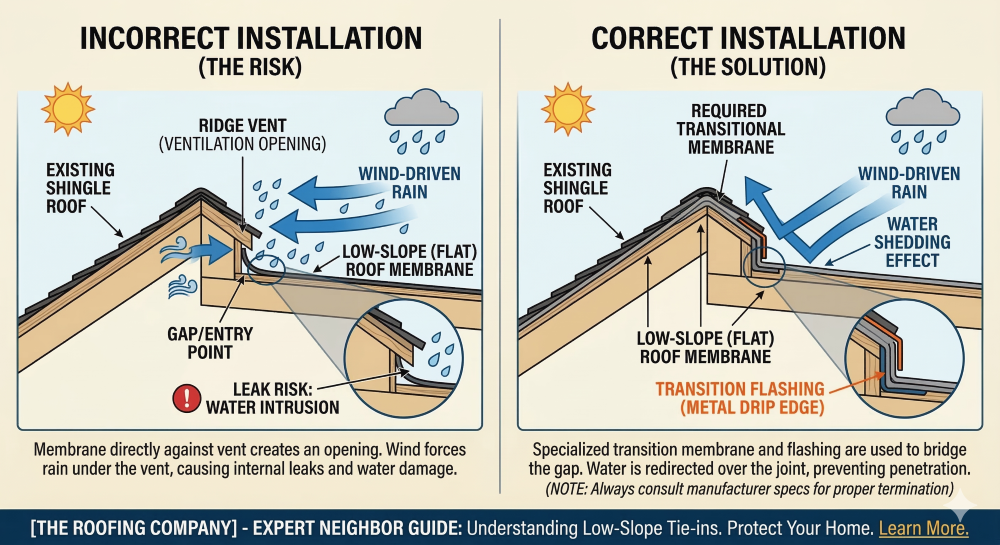
To help you visualize exactly why this is a recipe for disaster, we’ve created a quick guide. Take a look at the graphic below to see the "right way" versus the "wrong way":
Visualize the Problem: Right vs. Wrong
As the illustration shows on the "Incorrect" side, simply sticking the low-slope membrane right up to the ridge vent leaves an enormous gap for wind-driven rain to blow right in. It’s like leaving a window cracked open during a thunderstorm!
The "Correct" method is much safer: it uses a specialized transition membrane and robust metal flashing to redirect the water safely over the joint, even during our typical strong, driving rainstorms in Coastal Virginia. Ensuring these details are done correctly is what separates a long-lasting roof from one that leaks every time the wind blows.
Tags
Subscribe to The Roofing Company's Blog





Comments