Our Craft: Asphalt, Slate, Metal, Flat Roofing, Masonry & More
Think of your roof like a heavy winter coat; eventually, the fabric thins and the zippers fail. In our neck of the woods, you’ll want to look for shingles that are curling at the edges or "balding" (where the protective granules have washed into your gutters). Inside the house, keep an eye out for brown spots on the ceiling or peeling wallpaper. As it turns out, even a small damp spot can be a sign that the salt air and humidity have finally found a way in.
It’s all about finding someone who treats your home like their own. You want a team that is licensed, insured, and—most importantly—local to the Peninsula or the Southside. Ask for references from neighbors in your specific city. We always say the lowest bid isn't always the best "win" if it means cutting corners on the materials that protect your family during a midnight Nor'easter.
Every home is a little different, but our crew generally gets the job done in anywhere from a single day to a few days for more complex projects. We keep a close eye on the Tidewater weather forecasts to make sure your home is never left vulnerable to a surprise afternoon thunderstorm. We’ll give you a clear timeline before we ever move the first shingle.
There isn't a one-size-fits-all price because things like the "pitch" (the steepness) and the "decking" (the wooden boards under your shingles) vary from house to house. We like to help homeowners look at the "annual cost"—taking the total price and dividing it by the life expectancy of the roof. It helps turn a big number into a manageable investment for your peace of mind.
Not at all. While architectural shingles are a staple across the Peninsula, we’ve spent decades mastering the distinct needs of every roofing style. Whether your home calls for the sleek protection of metal, the classic feel of tile, the prestigious quality of natural slate, or even flat roofing solutions for modern designs and additions, our team has the specialized training to handle it all.
Because we deal with everything from coastal humidity to high winds, the "best" material depends on your home’s "bones."
Asphalt Shingles: A reliable, versatile choice for most homes in Newport News and VA Beach.
Metal & Tile: Exceptional for high-wind gusts and long-term durability.
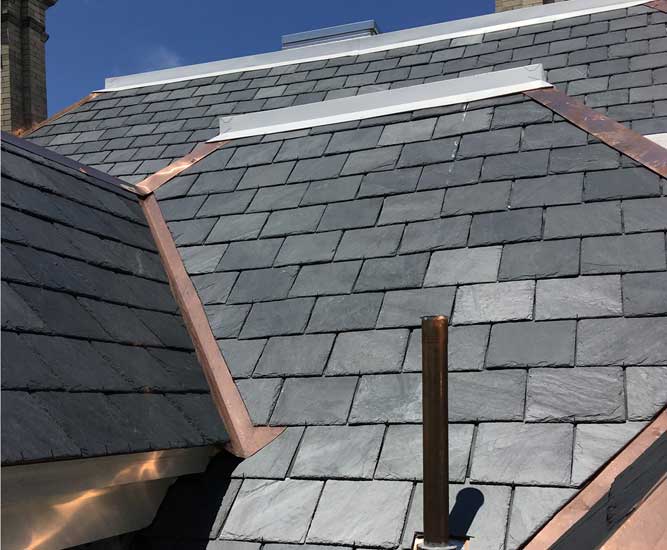
Slate (The "Gold Standard"): This is a true passion for us. We even offer a patented lightweight slate system that provides 100-year protection for almost any home—even those originally built for shingles.
Flat roofs (or "low-slope" roofs) are common on porches, garages, and even many of our local commercial buildings throughout the Southside. However, they require a completely different kind of expertise than a standard sloped roof.
Because water doesn't run off them as quickly, you can’t treat them like a shingled roof. Whether it’s a small residential sunroom or a large commercial space, we use specialized membranes designed to create a seamless, watertight seal. As it turns out, getting the drainage and sealing right on a flat roof is the secret to keeping the rooms (and the businesses) underneath tucked away safe and dry during a week of Virginia rain.
We certainly do. We stand behind our team’s craftsmanship and the high-quality materials we use. We’ll walk you through the specifics of both the manufacturer’s warranty and our own workmanship guarantee, so you can sleep soundly knowing your investment is tucked away safe and dry.
Roof Replacement: Planning for the Long Haul
It’s a bit like an old pair of boots; you can resole them a few times, but eventually, the leather itself starts to give way. If you find yourself calling us after every big summer thunderstorm or if you're seeing "balding" shingles (where the protective granules are filling up your gutters), it’s usually a sign the material has reached its limit. We look for the "why" behind the leak—if the shingles are brittle or curling across the whole roof, a replacement is the only way to ensure your family stays tucked away safe and dry for the next twenty plus years.
We don’t believe in just covering up an old problem. At The Roofing Company, Inc., we take a "top-to-bottom" approach:
The Tear-Off: We remove every old shingle to get a clear look at the decking (the wooden boards underneath). If there’s hidden rot from our coastal humidity, we fix it now so it doesn't haunt you later.
The Underlayment: Think of this as a high-tech rain jacket that lives under your shingles. It’s your last line of defense during a Nor'easter.
The Installation: Whether you've chosen asphalt, metal, or our lightweight slate, our crew installs it as a complete system, including new flashing (the metal "weather-stripping" around chimneys and valleys) to keep water out of the most vulnerable spots.
Most of our neighbors are surprised to find out that a typical replacement only takes a day or two. We coordinate our crews like a well-oiled machine to minimize the "construction zone" feel. We also keep a very close eye on the Tidewater weather reports—we won’t start a project unless we have a clear window to get your home "dried in" and protected before the next rain rolls through.
In a perfect world, a roof would last forever. But here in Tidewater, our roofs have to work a little harder against the salt air and coastal winds. While every home is different, the American Society of Home Inspectors gives us some great benchmarks for what to expect:
Asphalt Shingles: Usually 15–20 years. They are the "reliable workhorses" of the Peninsula.
Metal Roofing: These can last anywhere from 15 to 75 years depending on the style.
Wood Shingles/Shakes: Typically 10–40 years, though they require a bit more "neighborly love" (maintenance) to hit that upper mark.
Slate (The "Forever" Roof): This is the gold standard, lasting anywhere from 75 to 200 years.
As it turns out, the secret to hitting those high numbers isn't just the material; it’s about proper installation and routine check-ups. Think of it like a car—you wouldn't drive 100,000 miles without an oil change. A little maintenance goes a long way in ensuring your home stays tucked away safe and dry for as long as possible.
As it turns out, your roof is a major player in your home’s climate control. A properly installed roof with modern ventilation acts like a vent for your attic. In the middle of a humid Virginia July, that keeps your AC from having to work overtime to fight the heat trapped above your head. It’s a great "win" for your comfort and your wallet.
Slate Roofing: The "Forever" Roof
Slate is often called the "forever roof," and for good reason. It’s a natural stone, which means it doesn't mind the salt air or the intense sun we get on the Southside and the Peninsula. Unlike synthetic materials that can fade or become brittle over time, slate is naturally fireproof and incredibly durable.
As it turns out, slate is one of the most long-lasting materials on the planet. A properly maintained slate roof can protect a home for 75 to several hundred years. In fact, we’re partial to Virginia Buckingham slate, which is world-renowned for its durability—it’s been known to keep homes tucked away safe and dry for 200 years or more. When you look at the "annual cost" over a century or two, it’s easily the smartest investment you can make for your home’s future.
This is a question we hear a lot! Traditionally, natural stone is very heavy, and many homes built for shingles aren't framed to support that kind of weight without expensive structural reinforcement.
The Neighborhood Secret: At The Roofing Company, Inc., we offer a patented lightweight slate system. It uses that same genuine, high-quality slate but is engineered to be installed on almost any home. It’s a game-changer because it allows you to get that prestigious "200-year" protection without the need for extra beams or supports. As it turns out, you don't need a historic mansion to have a world-class roof.
Even a "forever roof" like slate needs a little neighborly look-see every now and then. We generally recommend having us out for an inspection every 12 to 18 months, or definitely after one of our bigger coastal storms. Our team takes a "top-to-bottom" look at the entire system—not just the stone, but the flashing (the metal seals) and the gutters—to catch those tiny issues before they ever turn into a midnight leak.
At The Roofing Company, Inc., these visits actually serve a dual purpose:
Company Accountability Inspection: This is how we hold ourselves to the highest standard. We come back to check our own craftsmanship, ensuring that everything we installed is performing exactly the way we promised it would.
Customer Appreciation Inspection (CAI):: As a token of our appreciation, we’re proud to offer this exclusive service for the residential single-family homes we’ve worked on. It’s a complimentary "health check" to ensure your investment is sound and to give you total peace of mind that your family is tucked away safe and dry.
That’s one of the best parts about a slate system. If a stray branch hits your roof during a coastal storm and cracks a tile, you don't have to worry about replacing the whole thing. Our team can come out and "hook" in a new piece of matching slate. It’s a simple, targeted fix that keeps your roof looking perfect and your family protected.
It certainly does. Because it’s a natural product of the earth, slate comes in beautiful, organic tones—from deep unfading blacks and greys to "weathering" greens and purples that develop a stunning patina over time. We love helping neighbors find the specific shade that makes their home the standout of the block.
Ventilation: Helping Your Home Breathe
Think of your attic like a pair of lungs. In the middle of a humid Virginia July, heat gets trapped up there. If that hot air has nowhere to go, it "bakes" your shingles from the inside out, causing them to age much faster than they should. Proper ventilation creates a constant flow of fresh air, keeping your attic cool and extending the life of your roof. As it turns out, a "breathing" roof is also a huge win for your power bill, as your AC doesn't have to fight the heat trapped right above your ceiling.
There are a few "neighborhood secrets" to spotting a ventilation issue without even climbing a ladder. If you notice your upstairs rooms are significantly hotter than the downstairs, or if you see ice dams forming on the eaves during a rare local freeze, your attic might be holding onto too much heat. Inside the attic, look for dampness or a musty smell—that’s often a sign that our coastal humidity has moved in and doesn't have a way out.
There isn't a one-size-fits-all answer, but we usually look at two main things:
Ridge Vents: These sit at the very peak of your roof and let the hottest air escape naturally.
Soffit Vents: These live under the eaves of your roof and pull cool, fresh air in.
Powered Fans: Sometimes, especially on larger homes in the Southside, we might suggest a solar or electric fan to give the air a little extra "nudge."
Our team always checks your ventilation during an inspection to make sure your home has the perfect balance to stay tucked away safe and dry.
Masonry & Chimneys: The Most Vulnerable Spot
Chimney leaks can be a bit like a mystery novel—the culprit isn't always obvious at first glance. Because the chimney sits at the highest point of your home, it takes the full brunt of our Virginia Nor'easters and salt air.
Common "hidden secrets" behind a leak include:
The Chimney Crown: The concrete "hat" on top. If it has tiny cracks, water seeps in and freezes, making the cracks bigger.
Deteriorated Mortar Joints: The "glue" between your bricks can crumble over time, especially in our humid coastal climate.
Damaged Flashing: This is the metal "collar" where the chimney meets the roof. If this isn't sealed perfectly, water will find its way into your attic.
The Chimney Cap: If the metal cap is missing or rusted through, it’s basically an open door for rain.
As it turns out, a leak might have two or three of these causes working together. Our team doesn't just "patch" the problem; we perform a thorough inspection to make sure we’re protecting your home from the top down.
Absolutely. While we love the character of the historic brickwork found throughout the Peninsula, we work on all types of masonry chimneys. Whether it’s stone, block, or traditional brick, masonry is a specialized skill that requires a different touch than standard roofing. Since we specialize in historic homes, we understand the importance of matching materials and techniques to the original "soul" of the building.
It definitely can. As it turns out, if the masonry on your chimney is "spalling" (when the faces of the bricks start to pop off) or the mortar is failing, that moisture can travel downward and rot the decking (the wood) under your shingles. Keeping your chimney healthy is one of the best ways to ensure your entire roofing system stays tucked away safe and dry.
Gutter Systems: The "Moat" Around Your Home
In our part of Virginia, we deal with a lot of sandy soil and heavy coastal downpours. Without a solid gutter system, all that water falling off your roof acts like a power washer against your foundation. It can lead to basement leaks or even "settling" issues. Think of your gutters as a strategic moat—their only job is to catch that water and move it safely away from your home so you can stay tucked away safe and dry inside.
While standard aluminum gutters do a fine job, many of our neighbors choose Premium Gutters like Copper or Zinc —especially when they’ve invested in a slate or tile roof.
Copper: It’s the "jewelry" of the house. It starts with a bright shine and eventually develops a beautiful green patina that looks stunning in historic neighborhoods like Ghent or Old Wythe.
Durability: These materials don't just look better; they last for decades and won't rust out from the salt air we get on the Southside.
If you live in a beautiful historic home in Portsmouth or Williamsburg, you might have Internal (or Box) Gutters. Instead of being attached to the outside of the house, these are actually built into the roof structure or the cornice. They are invisible from the street, which keeps the historic "soul" of the home intact. However, they are a specialized craft. If they leak, the water goes straight into your walls, not outside. Our team specializes in relining these with modern, durable membranes to ensure they stay hidden but effective.
We certainly do. Commercial gutter systems are a different beast entirely. They have to handle a much higher volume of water from large, flat roofs. We use heavy-gauge materials and oversized downspouts designed to keep water away from storefronts and warehouses. Whether it’s a local shop on the Peninsula or a large industrial space, we make sure the drainage is "set and forget" so you can focus on your business.
As it turns out, we have a lot of beautiful old trees in the Tidewater area, and their leaves love to call your gutters home. Gutter guards act like a filter, letting the water in while keeping the pine needles and debris out. It’s one of those "wins" that saves you from having to climb a ladder every fall.
Commercial Roofing: Protecting Your Business
At The Roofing Company, Inc., we believe in performance over a sales pitch. While we’re familiar with all the major systems, we base our recommendations on what actually survives the Tidewater sun and salt air.
Our Top Recommendation: FiberTite If you want the absolute "gold standard," this is it. FiberTite was first installed back in 1979, and as it turns out, it has over 45 years of proving it can handle the toughest environments. It’s engineered with a much heavier base fabric than your average TPO or PVC, which means it’s incredibly hard to puncture or tear. It also has a "secret weapon" formula that resists chemicals, grease, and fats—making it perfect for restaurants or industrial buildings. It’s not uncommon to see a FiberTite roof still going strong after 30 or 40 years.
See more: FiberTite Commercial Roofing VideosRegarding TPO and EPDM
We usually recommend TPO or EPDM if we’re repairing a section of a roof that already uses those materials. While FiberTite is our standard for quality, we understand that on very large-scale projects, the budget can sometimes be the deciding factor.EPDM (The "Old Pro"): Introduced in 1962, this is a durable synthetic rubber. It’s great for local temperature swings because it stays flexible in the cold. A well-maintained EPDM roof can often give you 20–30 years of service. EPDM Roofing Systems Videos
TPO (The "Newcomer"): TPO hit the US market in the 90s. It’s popular because its white surface is very energy efficient, reflecting that Virginia summer heat. It typically lasts about 20 years, though it doesn’t quite have the "heavy-duty" lifespan of FiberTite. GAF TPO Roof Installation Videos
As it turns out, the "best" roof depends on your specific building and your long-term goals. Our team is happy to stop by, take a look at your current structure, and help you navigate these choices so you get the best return on your investment.
Running a business in Hampton Roads is busy enough without having to worry about what’s happening on your roof. Generally, if you’re noticing water spots on ceiling tiles or an uptick in your cooling bills during a muggy July, it’s time for us to take a look. As it turns out, many commercial roofs—especially flat ones—can be "restored" or repaired if we catch the issues early. However, if the membrane is becoming brittle or if you’ve already patched it more than a few times, a replacement is often the most cost-effective way to ensure your business stays tucked away safe and dry.
This video demonstrates a specific part of the installation process for a FiberTite mechanical roof system.
We know that the last thing you want is a "construction zone" turning away your customers or distracting your team. Our crew coordinates like a well-oiled machine to keep our footprint small. We’ll work with you on a schedule that makes sense—whether that's staging materials out of the way of your main entrance or ensuring the loudest work happens during your off-hours. We treat your business with the same "neighborly" respect we’d show a home.
Real Estate & Transaction Estimates
Buying or selling a home in Tidewater is a big milestone, and the last thing you want is a "roof surprise" right before closing. Whether you’re a homebuyer needing a roof certification, a property manager looking after a rental, or a homeowner navigating an insurance claim, we’re here to help.
Because these assessments require a deep dive and detailed documentation for legal or financial use, we do charge a standard fee for the on-site inspection and the comprehensive report. As it turns out, this ensures you get a truly professional, unbiased look at the "bones" of the roof.
The Best Part: If you choose The Roofing Company, Inc. to handle the repairs or replacement found in our report, we apply that fee directly to your project. It’s our way of saying thanks for trusting us with the work, essentially making the inspection a complimentary part of the process.
Why do I need a specialized "Transaction Estimate"?
Standard estimates are often just a quick look at a visible problem. A Transaction Estimate is different—it’s a professional "paper trail." It provides the accurate, reliable information that banks, insurance companies, and real estate attorneys need to move a deal forward.
Whether you’re dealing with a "long-distance" property or a local historic estate, our reports give you the peace of mind that your investment is sound. We make it easy by accepting checks at the time of the inspection or credit cards over the phone so you can keep your focus on the closing.
Still Have Questions?
Every home and business in Hampton Roads has its own unique personality, and sometimes a general answer just doesn't cover it. Whether you’re dealing with a mystery leak on the Peninsula or you’re curious about how salt air is affecting your roof on the Southside, we’re always here to help. We believe in being a resource for our neighbors first and a roofing company second.
If you’re worried about a specific issue or just want a professional second pair of eyes to take a look, we’re happy to chat. You can reach the team at 757-867-6600 or use the form on this page for us to contact you.
Let’s Get You A Free Quote

Better Roofing by Better Roofers
The Proof is in the Roof
Dedicated to providing better roofing by better roofers, we lead the industry with emerging technologies and innovative techniques at our state-of-the-art training center.
Learn why our contractors are the most skilled experts in roofing.

12-Month No Payment, No Interest!
Enjoy 12 months of No Payment, No Interest on local roofing and skylight projects in the Virginia Beach and Hampton Roads, VA communities!